
The generative AI gold rush has produced a predictable outcome: a digital landscape saturated with robotic, undifferentiated content. LinkedIn, in particular, has become a sea of sameness, filled with posts that start with “In today’s fast-paced world…” and end with a string of generic hashtags.
For time-poor senior leaders at South African SMEs, this presents a frustrating paradox. The tool that promised to save time is now forcing you to waste it, creating content that fails to connect, convert, or build a brand.
The consensus is clear: AI-generated social media content is largely failing. This is a strategic failure, not a technical one.
The problem isn’t the AI. The problem is the process.
Most organizations treat generative AI like a slot machine—plugging in a low-effort prompt and hoping for a jackpot. The real, defensible value is not in having access to the AI; it is in the proprietary, human-driven process you use to direct it. Your intellectual property is your framework.
This article gives you that framework. We are moving beyond simple prompting to outline a 1-hour AI social media content workflow designed for strategic leaders. This process will enable your team to generate a full month of authentic, high-impact, and distinctly human social media content that is deeply aligned with your brand and your specific South African market context.
The paradox of AI content: why more is less
The barrier to content creation has collapsed. Any intern can now generate 100 social media posts in an afternoon. The barrier to content impact, however, has never been higher.
When everyone has a megaphone, the only voice that cuts through is the one that speaks with clarity, authenticity, and relevance. Generic AI content, by its very nature, is trained on the average. It regresses to the mean, producing content that is:
Strategically drifting: It is “about” your topic but lacks a connection to your quarterly business objectives, your target audience’s immediate pain points, or your unique brand narrative.
Tonally deaf: It fails to capture your brand’s specific voice. Is your persona the seasoned advisor, the disruptive innovator, or the empathetic partner? An AI does not know unless you provide a high-fidelity brief.
Context-blind: It does not understand the nuances of the South African market. It will not organically reference the impact of load-shedding on business continuity, the complexities of B-BBEE (External Link: [Authoritative guide to B-BBEE compliance]), or the specific aspirations of an emerging middle class. It speaks to everyone, and therefore, to no one.
This “content-for-content’s-sake” approach is not just ineffective; it is a liability. It erodes brand equity and wastes your team’s most valuable resource: focus.
Stop prompting, start directing: the framework is your new IP
The required shift in thinking is profound. You must stop seeing your team as “prompt engineers” and start seeing them as “strategic directors.” The AI is a hyper-efficient, infinitely scalable intern. Like any intern, it is useless—or even dangerous—without a world-class brief. (Internal Link: [Our services on brand strategy development])
Your competitive advantage, your “AI-resistant” moat, is the quality and structure of that brief. The value is 10% in the tool and 90% in the workflow that feeds the tool.
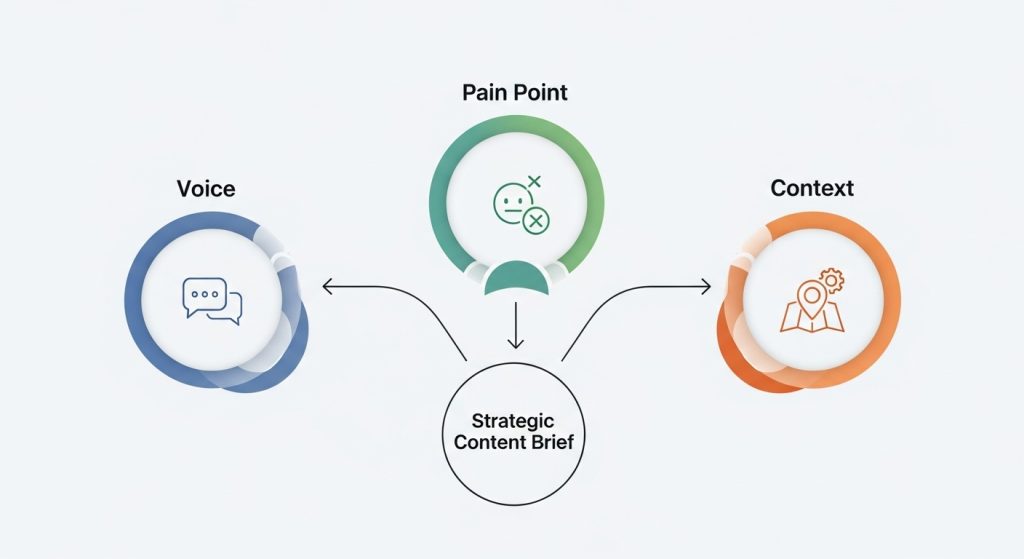
We call this workflow the Strategic Content Brief (SCB). It is a structured process that transforms your core strategy into a set of precise instructions that the AI can execute flawlessly. This workflow is built on three core components: Voice, Pain Point, and Context.
The 1-hour AI social media content workflow in practice
This entire process is designed to be completed in a single 60-minute focused session by a marketing manager, social media lead, or even a founder.
Phase 1 (The one-time setup): defining your core content DNA (0 mins)
This is not part of the 1-hour workflow because it must be a foundational brand asset. If you do not have this, this is your first task. You cannot direct the AI if you do not know who you are. Your Content DNA must be a simple, one-page document detailing:
Brand voice & persona: Are you “The Mentor” (authoritative, wise, guiding) or “The Challenger” (provocative, innovative, direct)? List 5-10 “is” and “is not” adjectives (e.g., “Is: Insightful, professional, concise. Is Not: Playful, salesy, academic.”)
Core customer pain points: List the top 3-5 specific problems your target audience (e.g., SA SME finance directors) faces. Go beyond the surface. Instead of “managing cash flow,” try “Managing volatile cash flow exacerbated by unpredictable load-shedding schedules and late payments from enterprise clients.”
Strategic content pillars: What are the 3-4 core themes you want to “own” in the market? (e.g., “AI-Powered Efficiency,” “Local Market Resilience,” “Sustainable SME Growth”). Every post must map back to one of these pillars.
Phase 2 (15 mins): strategic ideation & thematic clustering
In this phase, you will use the AI for what it does best: rapid, large-scale pattern recognition and ideation. You are not asking it to write posts yet.
Your Goal: Generate 30-40 high-potential ideas (angles, questions, data points) and cluster them into four weekly themes.
Example Prompt:
“Act as a strategic content director for a B2B tech firm targeting South African SME leaders. My Content DNA:
Persona: The Pragmatic Innovator.
Voice: Authoritative, clear, practical, forward-looking. Avoid marketing jargon.
Audience Pain Points: 1) Wasting money on tech that doesn’t deliver ROI. 2) Struggling to scale operations due to manual processes. 3) Business disruption from infrastructure issues (e.g., load-shedding).
Content Pillars: 1) Practical AI Implementation, 2) Operational Resilience, 3) Scalable Growth.
Task: Generate 30 distinct social media post ideas (not full drafts) for LinkedIn. Each idea should be a compelling question, a surprising statistic, a contrarian viewpoint, or a ‘how-to’ angle. Map each idea to one of the three Content Pillars.”
Human Step (The “15-Minute” Part): You will now get a list of 30+ ideas. Your job is to curate, not create. Scan the list and cluster them into four logical weekly themes. (Internal Link: [Guide to creating a content calendar])
Week 1: The ROI of AI (Pillar 1)
Week 2: Building a Resilient Business (Pillar 2)
Week 3: Myth-busting AI (Pillar 1)
Week 4: Scaling Smart (Pillar 3)
You now have a one-month strategic content calendar.
Phase 3 (30 mins): the "strategic batching" prompt framework
This is where you execute. You will not prompt for one post at a time. You will “batch” an entire week’s worth of content in a single, comprehensive prompt. This ensures tonal consistency and massive time savings.
Your Goal: Generate the first draft of all 30 posts, batched by your weekly themes.
Example Prompt (for Week 1):
“Excellent. Now, let’s draft the posts for Week 1.
Theme: The ROI of AI
Persona & Voice: Act as ‘The Pragmatic Innovator’ (Authoritative, clear, practical, forward-looking). Write in the active voice. Do NOT use robotic phrases like ‘In the digital age,’ ‘It’s crucial to,’ or ‘Unlock the power of.’
Audience & Context: South African SME leaders. Posts should be direct and acknowledge their specific context (e.g., cost-conscious, time-poor).
Task: Write 7 high-impact LinkedIn posts based on the ideas below. Each post must:
Be between 80-120 words.
Start with a strong, scroll-stopping hook.
End with a direct question or a clear call-to-thought to drive engagement.
Post 1 Idea: Stop asking ‘what is AI?’ and start asking ‘what is its ROI?’
Post 2 Idea: Data point: AI can cut ops costs by 30%, but 90% of SMEs fail at implementation. Why?
Post 3 Idea: A local SA SME case study (hypothetical) on using AI to manage supply chains during load-shedding.
Post 4 Idea: Common objection: ‘AI is too expensive for an SME.’ (Bust this myth).
Post 5 Idea: A practical tip: One manual process you can automate this week.
Post 6 Idea: Contrarian take: ‘Your team’s AI literacy is more important than your tech stack.’
Post 7 Idea: Question: What’s the #1 manual process you wish you could automate?
Generate all 7 posts.”
Repeat this process for your other three weekly themes. In 30 minutes, you will have 30 strategic, first-draft posts.
Phase 4 (15 mins): the human-centric polish (the 10% that matters)
This is the most critical step. Never copy and paste directly from the AI. The AI gets you 90% of the way there. The final 10% is where you inject the human “soul.”
Your Goal: Review all 30 posts and make high-leverage edits.
Your 15-Minute Polish Checklist:
Does it sound like me? Read it aloud. Tweak 3-5 words in each post to match your unique cadence. (e.g., Change “It is imperative” to “You must.”)
Is the hook sharp enough? Make the first sentence shorter. More direct.
Is the local context right? Can you add a uniquely South African reference that the AI missed? (e.g., “…before the next round of load-shedding hits,” or “…that’s more than a new inverter.”)
Is the Call-to-Action (CTA) clear? Sharpen the final question.
This 15-minute human filter is what elevates the content from “good AI post” to “great strategic post.”
Why this AI social media content workflow is a game-changer for South African SMEs
This structured AI social media content workflow moves you from a state of reactive “content churn” to proactive, strategic communication.
For South African SMEs, the advantages are not trivial:
Levels the playing field: You do not need a 10-person marketing agency. This workflow gives you the process of a top-tier consultancy, executable by one person in one hour a month. (Internal Link: [Our fractional CMO services for SMEs])
Embeds local relevance: By making “SA Context” a core part of the framework, you ensure your content speaks directly to your audience’s reality, building a level of connection that global, generic content can never achieve.
Frees up leadership: This process is efficient, delegable, and, most importantly, repeatable. It frees senior leaders from the content treadmill to focus on what they do best: driving the business forward.
Generative AI is a commodity. Everyone has access to the same tools. The new competitive battleground is process.
The deluge of robotic content from your competitors is not a threat; it is an opportunity. While they are busy polluting the feed with low-effort, low-impact noise, you can cut through with a clear, strategic, and authentic voice.
We have given you the framework. The AI is the engine, but this AI social media content workflow is the steering wheel, the map, and the destination. Stop feeding the content machine and start directing it. Take one hour this week, implement this framework, and reclaim your brand’s voice.
Signup for our monthly emails